
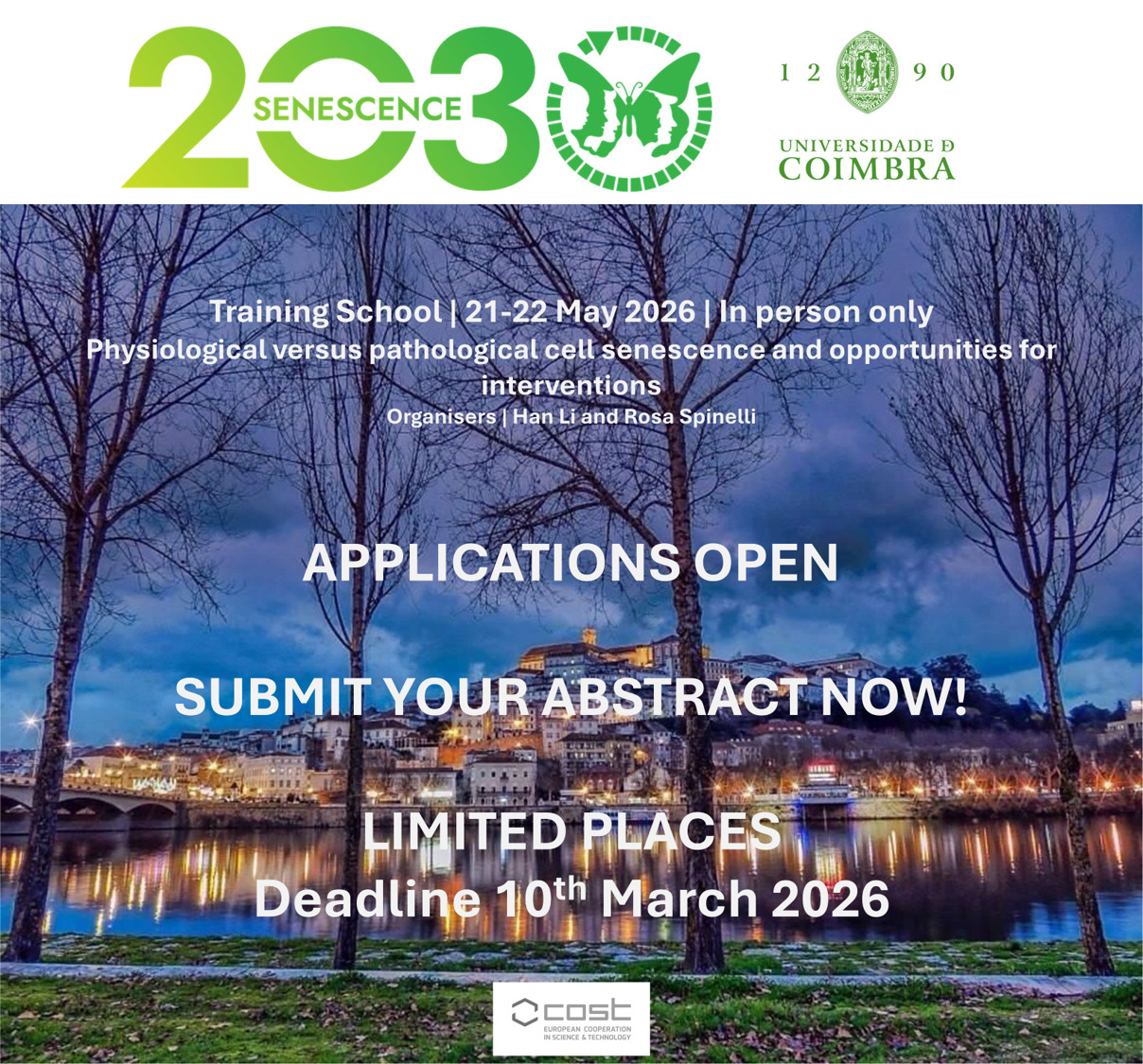
Held in conjunction with the Senescence2030 Annual Conference, 19–20 May 2026
Deadline for application and Abstract submission to the Training School | 10th March 2026
Advancing Senescence Research from Mechanisms to Interventions
The COST Action SENESCENCE2030 – Targeting Cell Senescence to Prevent Age-Related Diseases is pleased to announce its 2026 Training School, entitled “Physiological versus Pathological Cell Senescence and Opportunities for Interventions”, to be held in Coimbra, Portugal, from 20 to 22 May 2026, in close synergy with the Senescence2030 Annual Conference (19–20 May 2026).
This interdisciplinary Training School is designed to provide participants with a cutting-edge, integrative perspective on cellular senescence, addressing its beneficial and detrimental roles across the lifespan, its contribution to age-related diseases, and the emerging opportunities for safe, effective, and evidence-based intervention strategies across experimental and translational contexts.
Scientific Rationale and Scope
Cellular senescence is now recognized as a key hallmark of aging, playing a dual role in development, tissue repair, and tumor suppression, while also contributing to chronic inflammation, metabolic dysfunction, cardiovascular disease, neurodegeneration, cancer, and immune decline when dysregulated.
Despite remarkable progress, critical challenges remain:
- distinguishing physiological versus pathological senescence,
- understanding tissue-, cell type-, and context-specific heterogeneity,
- identifying robust biomarkers and diagnostic strategies, and
- translating mechanistic insights into safe and effective clinical interventions.
The SENESCENCE2030 Training School 2026 directly addresses these challenges by offering an integrated and multidisciplinary perspective, bridging basic biology, translational research, clinical perspectives, and technological innovation, fully aligned with the mission of the COST Action to promote healthy aging through evidence-based, responsible strategies and cross-sector collaboration.
Scientific Structure
The Training School combines advanced lectures, trainee-driven sessions, interactive round tables, and direct engagement with industry and stakeholders, fostering both scientific excellence and professional development in a highly interactive training-oriented format.
What to Expect
- Five advanced thematic sessions (90 minutes each) delivered by leading international experts in cellular senescence, immunology, metabolism, cardiovascular biology, and translational research.
- Active trainee engagement at the core of the School, including:
- flash talks,
- poster presentations integrated with the Senescence2030 Annual Conference,
- active involvement in the Senescence2030 Workshop on Innovation in Cell Senescence Detection and Treatments, with direct interaction with industry and pharma representatives.
- Round tables and open discussions focusing on senescence across model systems (from cell cultures to humans through model organisms), and on opportunities, limitations, and challenges for senescence-targeting interventions.
Programme Highlights
Lecture topics will cover:
- Beneficial and detrimental functions of cellular senescence across the lifespan.
- Senescence heterogeneity and in vivo biomarkers.
- Immune–senescence crosstalk in chronic inflammation and age-related diseases.
- Senescence in metabolic tissues: mechanisms, consequences, and translational opportunities,
- Immune dysregulation, inflammation, and senescence in cardiovascular disease.
- Cellular senescence in cancer and the tumour microenvironment.
- Advanced and emerging technologies to detect, characterise, and modulate senescence in vivo and across tissues.
Learning Outcomes for Trainees
By the end of the Training School, participants will:
- Gain a comprehensive, critical, and up-to-date understanding of cellular senescence in physiological and pathological contexts.
- Acquire conceptual and methodological frameworks to study senescence across tissues and experimental models.
- Understand the translational potential, limitations, and risk of senescence-targeting strategies.
- Develop networking skills and collaborative connections with leading researchers, clinicians, industry, and pharma representatives.
- Enhance their scientific visibility through poster sessions, flash talks, and discussions, fostering opportunities for joint publications, collaborative projects, and future funding applications.
- Receive a Certificate of Attendance issued by the COST Action SENESCENCE2030.
Benefits for Trainers and the SENESCENCE2030 Community
The Training School represents a core Capacity Building activity of SENESCENCE2030, offering trainers the opportunity to:
- Contribute directly to training the next generation of senescence and geroscience researchers.
- Promote cross-disciplinary dialogue between academia, clinics, and industry, strengthening European leadership in the field.
- Identify promising early-career scientists for future collaborations, Short-Term Scientific Missions, and joint research initiatives.
Who can apply
Admission to the Training School is open to researchers at different career stages, including PhD students, postdoctoral fellows, early- and mid-career researchers, and clinicians, subject to the availability of places and the scientific evaluation of applications.
A strong emphasis is placed on inclusiveness, gender balance, and the active participation of Early Career Investigators.
Eligibility for COST financial support
Eligibility for COST financial support (reimbursement) is strictly limited to applicants who are members of the COST Action CA23119 (SENESCENCE2030) and who have applied to and have been formally accepted to the Training School.
Applicants who are COST members but not affiliated with the SENESCENCE2030 Action, as well as European researchers who are not COST members and applicants from non-COST countries, may be admitted to the Training School if selected. However, they are not eligible for COST reimbursement, and their participation will be entirely at their own expense.
Eligible participants will receive COST financial support in the form of travel reimbursement and a daily allowance, in accordance with the official COST Annotated Rules. Reimbursement applies exclusively to participants who are formally invited and accepted through the e-COST platform as eligible Action participants.
Abstract Submission and Application Procedure
Selection of trainees for the Training School will be based on the scientific quality and relevance of a submitted abstract. Applicants are invited to submit an abstract describing their current research and methodological expertise related to cellular senescence.
Abstracts should be structured and include the following elements: background and scientific context; a clear description of the research question or objective; methods and/or approaches; results; and conclusions and relevance to senescence research.
Abstracts should not exceed 300 words and must clearly indicate how the proposed work aligns with the themes of the Training School, including physiological and pathological senescence, biomarkers, heterogeneity, translational approaches, and intervention strategies.
Abstracts must be submitted as a single PDF file and must include the full list of authors and their affiliations. The submitting author must be the presenting author and should be listed as the first author.
Abstract should be sent simultaneously to both Training School Coordinators at the following email addresses: rosa.spinelli2@unina.it and han.li@pasteur.fr.
The deadline for abstract submission and application is 28 February 2026.
All correspondence related to the evaluation process and Training School acceptance will be sent exclusively to the presenting (first-named) author, using the contact email address provided during the application process.
Applications will be evaluated based on scientific quality, relevance to the Training School themes, and alignment with COST principles of excellence and inclusiveness.
Selected applicants will be notified of the selection outcome by 19 March 2026.
Programme
Coimbra, Portugal (20-22 May 2026)
Faculty of Medicine building (Polo I), second floor,
University of Coimbra, Rua Larga, 3004-504
Wednesday, May 20
13:00 – 15:00 Poster session by fellows in the Training School to foster early networking, stimulate discussion, and encourage interaction among participants.
15:00 – 17:30 Senescence2030 Workshop on Innovation in Cell Senescence Detection and Treatments, where trainees will actively engage with representatives from industry and pharmaceutical sectors, as preparation for the remainder of the Training School.
Thursday, May 21
9:15 – 9:30 Opening session: welcome, overview of the Training School programme, and general introduction.
9:30 – 10:00 Flash talks by 5 fellows of the Training School, five minutes each, presenting their research interests.
10:00 – 11:30 Session led by Prof. Daniel Munoz-Espin on “Senescence in the tumour microenvironment and therapeutic strategies”.
11:30 – 12:00 Coffee Break
12:00 -13:30 Session led by Prof. Pasquale Maffia on “Immune dysregulation in cardiovascular disease: from novel mechanisms to therapeutic targeting”.
13:30 – 14:30 Lunch Break
14:30 – 15:00 Flash talks by 5 fellows of the Training School, five minutes each, presenting their research interests.
15:00 – 16:30 Session led by Dr. Ignacio Palmero on “Understanding developmental senescence”.
16:30 – 17:30 Round table discussion on “Senescence from cell cultures to humans through model organisms”.
Friday, May 22
9:00 – 9:30 Flash talks by 6 fellows of the Training School, five minutes each, presenting their research interests.
9:30 – 11:00 Session led by Dr. Luca Pangrazzi on “Exploring techniques to study cellular senescence in immune cells”.
11:00 – 11:30 Coffee Break
11:30 – 13:00 Session led by Dr. Rosa Spinelli “Senescence in metabolic tissues: mechanisms, consequences, and translational opportunities”.
13:00 – 14:00 Lunch Break
14:00 – 15:00 Round table discussion on “Opportunities and challenges for senescence-targeted interventions”.
15:00 – 15:30 Concluding discussion led by Dr. Aniello Cerrato, Chair of the Action, translating key insights from the Training School into actionable perspectives for trainees and highlighting concrete opportunities for collaboration, mobility, and career development within the Senescence2030 network.